.avif)
Where the Farmers Went

Tristan Wilson
Almost every conversation I have had with someone in our industry in the last year ends at the same question…. "What about our people?"
It comes from owners, estimators, foremen, kids in trade school, admins, VP’s, fathers worried about sons, sons worried about fathers. The fear is similar. If AI does the takeoffs, and the agents create the schedules, and the rollers compact themselves - what is left for the human being who has spent thirty years learning how to build a road or move dirt?
It is a fair question. It deserves a real answer.
The short version is this: We have lived through it twice already in the last 150 years. And the math of the next 50 years makes the jobs panic almost impossible. There will be more work to do in American civil construction in 2040 than there is today, not less, and the people doing that work will be more valuable than the people doing it now, not cheaper.
I. The Math Doesn't Work
Start with the headline.
American construction is short ~500,000 workers right now, and the gap is widening. The youngest of the baby boomers turns 62 this year. The pipeline of new tradespeople is not big enough to replace the retirements that are already in motion, much less to meet demand from the largest infrastructure investment cycle in our lifetime.
Now zoom out.
The replacement fertility rate is 2.1 children per woman. Global fertility is already 2.2 and falling fast. Roughly 70 percent of humans now live in below-replacement countries. South Korea is 0.75. Italy is 1.2. Japan is 1.2. The United States hit 1.6 in 2024 - the lowest rate ever recorded in this country. Global population is projected to peak in 2064 at 9.7 billion, down to 8.8 billion by 2100, with 183 of 195 countries below replacement by century's end. The labor pool is contracting globally, and it is contracting first and fastest in the developed economies that build things.
If AI and robotics did not exist, we would be rationing construction. We would be deciding which bridges get built and which ones do not, because there would not be enough hands.
Instead, AI and robotics do exist, and they are arriving in our office and on our jobsite at exactly the moment our workforce begins to contract. The remaining human workers in our industry are not going to be at a discount. They are going to be at a premium. The field engineer who can direct twenty agents will be the most valuable field engineer any contractor has ever employed. The foreman who can orchestrate four autonomous dozers and a smaller paving train will make more money, not less.
II. We've Seen This Movie
In 1830, producing a bushel of wheat took an American farmer about three hours of labor with a cradle and a flail. By 1894, after the McCormick reaper and the steam thresher arrived, the same bushel took about ten minutes - a 95 percent drop in labor required per bushel.
Farmers panicked. Newspapers panicked. Labor organizers panicked. If one man with a machine can do the work of fifteen men with cradles, where do the other fourteen go?

Photo Credit: Reve
In 1891, an English economist named David Schloss got tired of the question and gave it a name. He called it the "lump of labour fallacy" - the false belief that there is a fixed amount of work in the world, so anything that makes a worker more productive must steal someone else's job. The amount of work is not fixed. When you make labor more productive, output gets cheaper, new things become possible, and people find work that did not exist before.
The data proved him right almost immediately. In 1890, 43 percent of the American workforce was employed in agriculture. By 1930, 21 percent. By 1970, 4 percent. Today, around 1.4 percent of Americans work in farming, and we feed ourselves and a chunk of the rest of the world.
The other 42 percent of the workforce did not go home. They built cars. They wired cities. They poured concrete. They laid asphalt. They flew planes that did not exist when their grandfathers were born. Total US employment went from about 23 million in 1890 to roughly 160 million today. Population went from 63 million to over 340 million. Unemployment averaged about 5 percent over the whole 130-year run, with no upward trend.
The panic came back in 1930. John Maynard Keynes coined the term "technological unemployment" and called it the central problem of the century. Stuart Chase published Men and Machines arguing that machines had outrun human consumption permanently.
Then the world ran the experiment.
From 1939 to 1979, the most automation-intensive forty years in human history - US manufacturing employment more than doubled, from 9.1 million to a peak of 19.6 million. Real wages tripled. The work week was shortened. Living standards exploded. The permanent technological unemployment never showed up.
And the same pattern played out somewhere even more important: food. In the 1960s, every serious development economist believed that mass famine was inevitable. A million dead in Africa and Asia by the 1970s was the consensus forecast. Then a wheat geneticist named Norman Borlaug bred new high-yield wheat varieties that, combined with mechanization and irrigation, tripled global grain yields. The famines never happened. Borlaug is credited with saving an estimated one billion lives.
The lump of labor fallacy has been wrong every single time it has been tested. But it’s the default emotion we feel when there is a technological breakthrough and the future feels so uncertain.
III. The Software Tell
If you want to see this movie before it plays in construction, walk down the street to software.
Our most productive engineer at Edgevanta is not doing the same job faster. He is doing a different job. He used to write code. Now he describes what code should do to Claude Code, in plain English, and reviews what comes back. A feature that took him a month last year ships in two or three days. Call the multiplier whatever you want - what changed is not his speed, it's the work. His judgment, architecture, and taste are now the bottleneck. Everything else got cheap.
This month I set up a second computer in my office that does nothing but run coding agents while I work on something else. I come back later and there is a finished tool sitting there. Sometimes I throw it out. More often I keep it. The work is getting done while I sleep.
That is what estimators, PMs, and supers are about to experience. Picture an estimator who finishes a takeoff Friday and leaves four agents running over the weekend - flagging risks against three years of historical jobs, shopping alternative materials, stress-testing the schedule against last summer's weather, drafting the bid narrative. Monday she walks in to a better bid than she could have built alone, and she still decides what to send. Picture a super whose agents quietly re-sequence the next two weeks overnight based on yesterday's production and tomorrow's forecast. Picture a PM who arrives to find all sixteen of last week's RFIs drafted, cross-referenced, and ranked.
Talented software engineers have never been more valuable. Elite compensation is hitting numbers that did not exist three years ago, with a handful of engineers being paid like NBA stars. Yes, big tech has done layoffs. Read past the headlines and most of it is unwinding the 2021 ZIRP over-hiring, not necessarily AI displacement.
The same will happen here. Taste, experience, judgment, and the ability to walk a job and move people will get more valuable. Clerical and repetitive work will shrink. Thirty years of pattern recognition will be worth more, not less.
IV. Abundance, Not Scarcity
Productivity revolutions do not just preserve output. They explode it.
A bushel of wheat that took three hours of human labor in 1830 takes about three seconds today. The price of food collapsed. The variety expanded. Calories per person doubled. Famine was the dominant threat to human existence for ten thousand years and then it became something Americans only read about.
The same pattern repeats in every industry that has ever industrialized. Cost per unit collapses by an order of magnitude. Demand expands faster than the cost falls. The value the industry creates goes up, by a lot.
What does that look like in civil construction?
Say a mile of four-lane interstate costs somewhere between $10 million and $20 million depending on geography. A medium-sized bridge over a small river runs $15 million and takes two years. We accept those numbers because we have always accepted them. We have never had a productivity revolution in heavy civil. Construction productivity has fallen 30 percent since 1970 while the rest of the economy doubled.
Now imagine the AI-native productivity curve actually catches up. A mile of interstate gets cheaper by half. A small bridge gets built in nine months. The site gets developed at 40 percent of today's number.
Does America build less infrastructure when infrastructure gets cheaper? No. America builds more. The backlog of deferred maintenance alone - roads, bridges, water, grid, ports - is in the trillions. The energy transition is in the trillions. The data center buildout is in the trillions. There is no realistic version of the next 25 years in which our industry runs out of work.
The pie does not stay the same size while AI eats a slice. The pie gets bigger.
So when someone pulls me aside and asks "what about our people?", this is the answer.
In 1890, when one McCormick reaper replaced the work of fifteen men with cradles, the country asked where the other fourteen would go. The fourteen wired the cities. They paved the highways. They flew the planes their grandfathers could not have pictured. The fourteen built the country.
The farmers did not disappear when the reaper showed up. They became the country.
The road builders will not disappear when the AI shows up. We will build the next one.
Bonus: Show Us Your War Room
Every team has one - the room where the bids get built and the schedule gets argued over until somebody calls it. We're starting a new feature: show us yours.
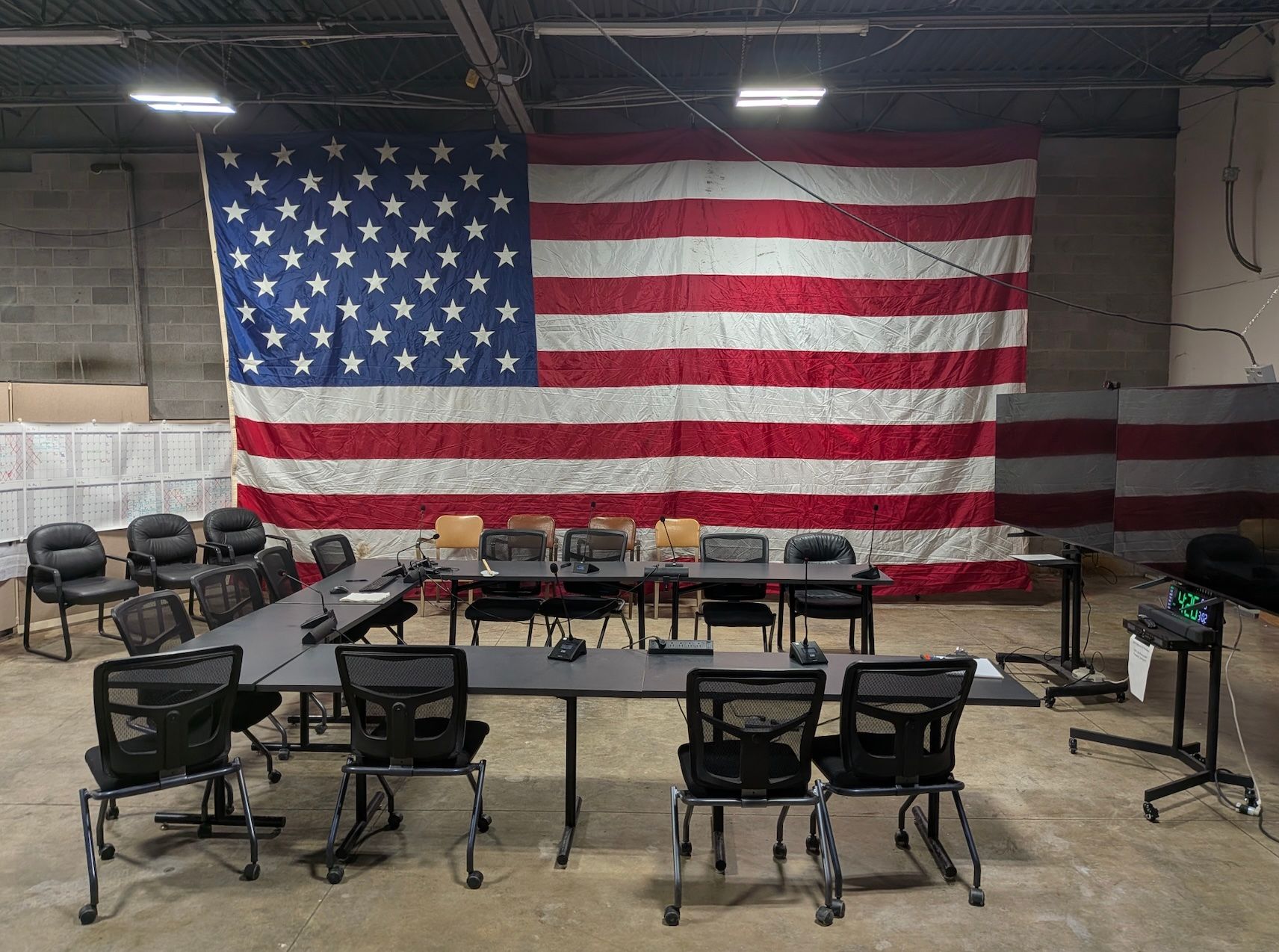
First up, our friend Bobby Steele at E&B Paving, who estimates and builds bridges across Indiana. We caught up this week and he sent the photo above. A few observations.
Seven microphones. Bobby is not running a war room, he is running a Senate subcommittee.
A shot clock on the credenza, for when the tieback install conversation crosses minute eight.
And a flag big enough to drop over a small building, in case anyone in the room forgets who they are building for.
This is a tough opener to follow but we encourage you to send your war room photos to be included in a future edition. Thank you for kicking us off, Bobby!
.avif)

.svg)