.avif)
Unreasonable Hospitality + Wally

Tristan Wilson
The best restaurant in the world once served its guests a $2 street hot dog.
A server at Eleven Madison Park overheard a table of tourists say they'd tried everything in New York except a dirty-water dog. So he ran out to a cart, bought one, and the kitchen plated it between courses of a tasting menu. Years later, that's the thing those guests still talk about. Not the caviar. The hot dog.

That story is from Unreasonable Hospitality by Will Guidara, the man who ran that restaurant, and his argument is simple: the food gets you in the game, but how you make people feel is what they never forget.
You've felt this in construction. If you've ever been prime on a job with a subcontractor who truly cares - shows up prepared, communicates, wants to do it right - you know the feeling. You can sense it in your body. Now flip the table: that's exactly what an owner feels when they draw a great contractor.
The bar in our industry is set so low that basic care, executed relentlessly, reads as unreasonable hospitality - and it costs you almost nothing.
One more thing before the list. Everything on it compounds. Every item is a deposit into an account with your name on it, and the balance is your reputation. Keep that in mind as you score yourself - because most of you reading this lead teams, and everything your team does is a representation of your company and of you. Intentions don't matter. Actions do.
1. Do work you'd sign your name to. Nothing matters more to an owner than knowing they drew the contractor who cares about what goes in the ground. It starts at the top - I've worked where quality was paramount, where it wasn't, and where it was a priority everywhere except my division. You can feel the difference walking onto the job. And quality isn't just field work: it's the submittals, the paperwork, and the punch list you knock out as you go instead of leaving a mess at the end. The last impression is the one that sticks.
2. Bring the 15 things. In the division I came up in, the pre-construction meeting had a playbook: these are the 15 things you bring. Hard copies in hand, electronic copies sent right after. We were far from perfect but we came prepared. A DOT engineer once pulled me aside and said, "I can't tell you how much we appreciate that. We never have to worry about you guys being on top of the paperwork." We never have to worry about you - that's the sentence you're trying to earn.
3. Billings so tight nobody argues. Especially on public work. Somebody owns reconciling quantities daily, weekly, monthly. Don't send the pay estimate and forget it - follow up, have the documentation ready, keep your numbers straight with the inspection staff. When owners know your billings are vetted, you get paid on time without a fight. That trust is worth real money.
4. Be early - especially on Zoom. Running late happens; a quick text fixes it. But if you're the face of your company and you're consistently late, it's just a bad vibe, man. Besides, the few minutes before the meeting starts is where the good conversations happen.
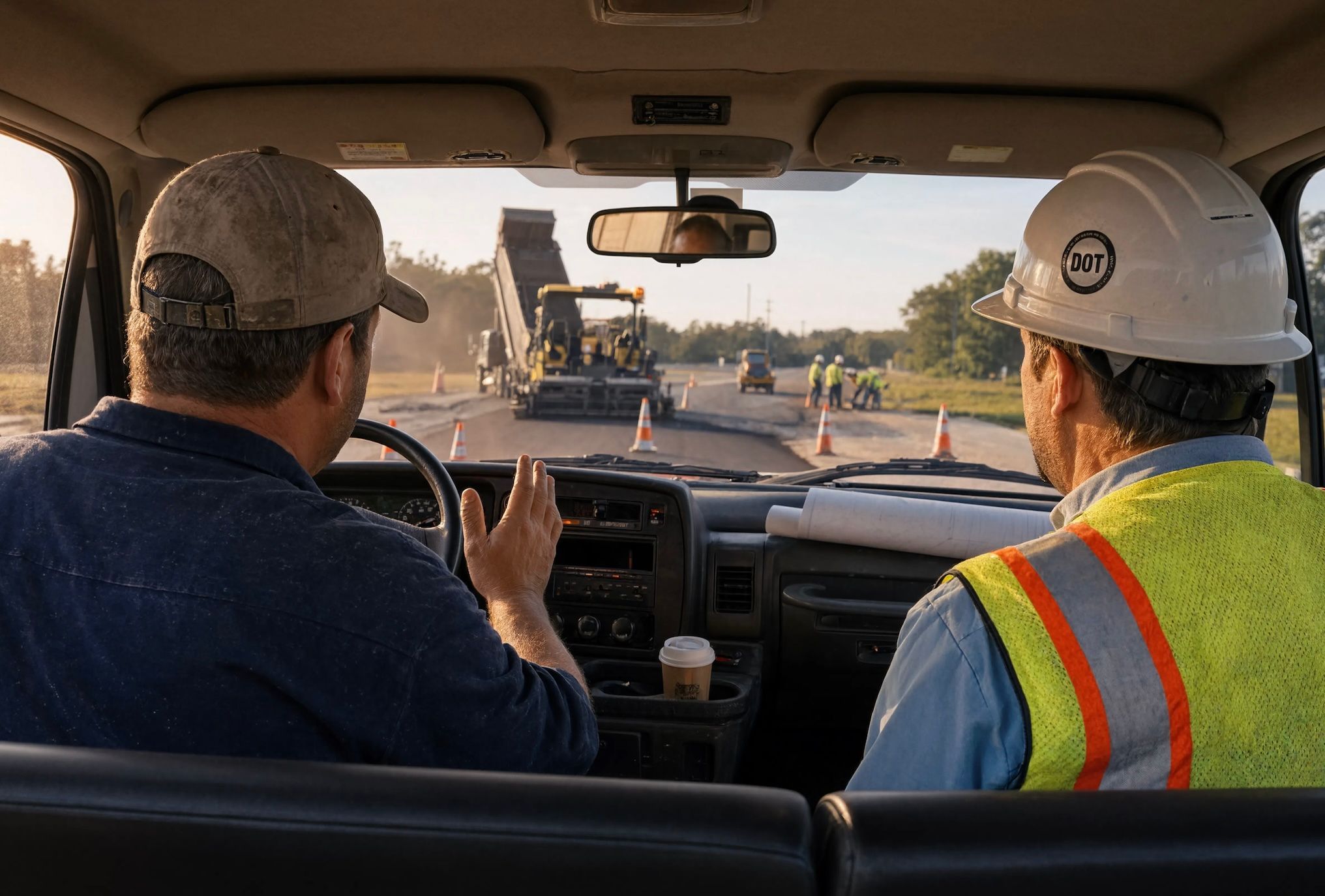
5. Send them your schedule. Then offer them shotgun. On one of the best jobs we ever had, we sent our internal weekly schedule - every crew, every truck count, night and weekend work - to the owner's whole team. They loved it: eight crews on a weekend means eight inspectors somebody has to line up. And when I'd visit a job and knew the engineer was nearby, I'd call: "I'm heading down - want to ride with me?" Thirty minutes of windshield time did more for those relationships than a hundred emails.
6. Answer fast, phone in the bag. Don't let emails sit. Don't let problems linger. Solve issues on the spot, and let your field people solve field problems. And when you're in the room, be in the room - phone in the bag before you walk in. Nothing infuriates an owner like a contractor who waits, and nothing flatters one like a contractor who's actually listening.
7. Never send the angry email. My drafts folder used to be full of masterpieces I rewrote ten times and never sent - and I'm glad, every single one. You can always send it tomorrow. Better yet, pick up the phone, and when they're hot, repeat their problem back in your own words. It forces you to understand it, it makes them feel heard, and it bleeds the tension off instantly. I've never once seen it hurt.
8. Keep the log. On a big job where utility delays and change orders doubled the contract value, we wrote down every issue as it came up and went over the list with the owner every week. New problems never stopped coming - but old ones kept closing, and eventually we took pride in it together: "72 issues resolved. We can handle whatever's next." That log turned an adversarial job into a team.
9. Assume they're one of the good ones. I've met some dud engineers - they're out there. But they're the exception. Most people at public agencies took the job because they care about their community, and most owner's reps want the project to succeed. Don't jump to conclusions when a call goes against you. Give the grace you'd want back.
10. When you're wrong, tear it out. My dad told me about getting black base approved on a city job. The third-party engineer stuck his neck out to approve the change - and our crew did a lousy job. He let us hear it: "I put my reputation on the line for you." So we tore it out and redid it, at our cost. Ten years later, he still hadn't forgotten. Admitting fault feels expensive in the moment; it's the cheapest investment you'll ever make. We're here to make money - but as my friend Jay Winford says, the job is to make a decent profit, decently.
11. Nothing leaves the building unread. Anything with your letterhead on it is a direct representation of who you are. And in the age of AI - I say this as someone who builds AI tools and recently got burned ignoring my own advice - a human reviews it before it goes out. I can tell in two seconds which emails were written by AI without edits, which by a person, and which by a person who used AI and then made it their own. Only one of those builds a reputation.
12. Lighten up - and be in it for the job. There are no prizes for being serious. Hold the standard - never lower yours because somebody else won't raise theirs - but laugh, get to know people, enjoy this. And check your motives while you're at it. For a good chunk of my career I was in it for me - making sure the jobs next to my name on the WIP made money. Many did. But people saw through it, and I didn't catch breaks I might have, because frankly I didn't deserve them. Owners can always tell who's in it for themselves and who's in it for the project. Care about the outcome, and the money follows.
Everything Compounds
Go back through the list and notice something: almost every story in it is about memory. The DOT engineer who said "we never have to worry about you guys" - he said that after years of 15-item packets, not one. The engineer on the black base job remembered one torn-out section for a decade. That's the math of reputation: the deposits are small and the interest is enormous, and it pays in whichever direction you've been depositing.
And this industry looks big, but count the people who actually matter in your market. It's small. Everybody talks. You get one reputation, and you're compounding it every day whether you mean to or not.
Notice what's not on this list: not one hunting trip, not one favor, nothing you couldn't tell your kids about. Owners value contractors who do quality, safe work, on time, who do what they said they'd do, and who are fair. The hospitality is just proof that you care.
If you only pick three to start: the billings, the 15 things, and the angry email. Then forward this to your team and ask one question - how are we doing on this stuff?
The bar is low. That's the opportunity: raise it up.
Thank you for reading this week!
This Week on The Edge Podcast 🎙️
Everything above is about how we treat owners. This week's guest spends his life on the other half of the equation: how we treat our own people.
I sat down with Wally Adamchik - Marine officer, UNC MBA, former Notre Dame leprechaun, author of No Yelling, and a man who has spent 20+ years teaching construction companies how to lead. Like me, he also grew up in a construction family. A client once told me, "We don't work with consultants. But we work with Wally." That's the best endorsement there is.
https://www.youtube.com/watch?v=aOHY3-itGAs&t=42s
A few things that stuck with me:
- "Well-led people are the best profit strategy." He used to say people are the best profit strategy. He changed it. The difference matters.
- Catch somebody doing something right. 79% of frontline leaders say they get real recognition monthly - or never. We live in a punch-list mentality: we fix what's wrong and ignore what's right.
- Your foreman is running a funded startup. A crew leader managing millions in work isn't a "paving guy." He's a business person. Train him like one.
- Best-in-class turnover is single digits. If your crew leaders' names were next to their retention numbers, would anything change? It did for us.
We also respectfully disagreed about whether chief estimators should still do takeoffs - which, if you read the silt fence essay, you know I had opinions about. Wally pushed back hard. It's a good fight.
Give it a listen: The Edge Podcast — Wally Adamchik
Find Wally on LinkedIn, at WallyAdamchik.com, or take his leadership assessment at ConstructionLeadership.com.
.avif)

.svg)