.avif)
The Man Who Builds Billion-Dollar Companies in “Boring” Industries

Tristan Wilson
I’ve probably sent this Brad Jacobs Founders Episode to a dozen people already.
Some conversations entertain you. This one changes how you look at your company.
Jacobs has built multiple multi-billion-dollar businesses in industries contractors know inside and out: waste, rentals, logistics, building-materials supply. Hard, physical businesses where execution is everything and there’s nowhere to hide.
And the guy seems genuinely happy. Not frantic or burned out. Just someone who has figured out how to operate at a high level without losing his mind.
There’s a line from the episode that I love:
“Mediocrity is always invisible until passion shows up and exposes it.”
Jacobs has spent forty years exposing mediocrity - calmly, repeatedly, and with a level of clarity most people never develop.
Pod:


Brad Jacobs, QXO, XPO, United Rentals & United Waste | David Senra
Book:
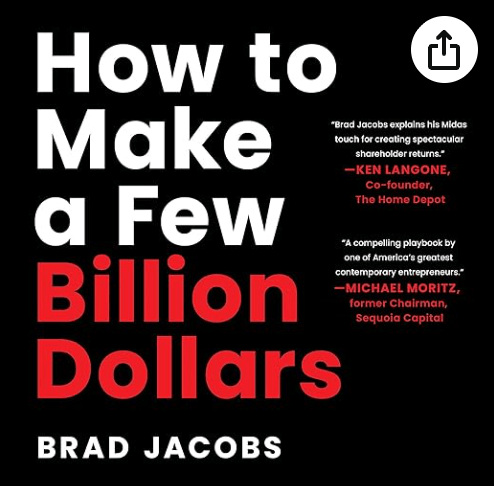
Photo Credit: Amazon
His résumé - simple and ridiculous
A quick run-through of his track record:
- Oil brokerage in the 70s — first win
- United Waste — built → sold for ~$2B
- United Rentals — turned a scattered industry into the global leader
- XPO Logistics — built a freight/logistics powerhouse
- GXO + RXO — more billion-dollar spinouts
- QXO — now building a national materials-supply platform
Nobody builds six multi-billion-dollar companies by luck.
There’s a repeatable pattern underneath it.
The Brad Jacobs Playbook
1. He starts where everyone else walks away
He gravitates toward messy, fragmented industries with slow change and no dominant player. Other people avoid that. He builds an empire out of it.
2. He finds the operators who make things happen
Jacobs is ruthless about talent. He talks openly about the massive gap between A, B, and C players - and how expensive it is to pretend those differences aren’t real. His best people get real upside and real ownership because they actually move the numbers.
He even runs a simple mental test: he imagines each key leader walking into his office and resigning. If the thought doesn’t bother him much, that person is not an A-player. If it guts him, they are.
He wants people who take ownership without being nudged, who run toward responsibility instead of waiting to be assigned it.
3. He builds one clean operating system
Every company he runs eventually operates off the same type of structure: clear workflows, shared information, and standardized decisions. Nothing fancy - just simple systems executed well.
4. He gets the truth before the meeting
This is one of his real superpowers.
Jacobs sends surveys ahead of major decisions. Short, direct questions. He reads everything. By the time he walks into a meeting, he already knows where the real issues are, without the distortion that happens when everyone gets in a room.
For a construction company, this is incredibly practical.
Imagine sending your foremen or PMs a three-question check-in every Friday. Your Monday meetings would start with clarity instead of surprises.
5. He ends meetings by lifting people up
He has this habit of asking himself afterward: “Whose star went up in that meeting?”
It forces him to notice real contributions in the moment - not months later at review time.
6. He decides quickly
He listens, synthesizes, and moves. No overthinking. No theatrics. Just forward motion. That rhythm compounds.
7. He stays curious and embraces tech - aggressively
Jacobs meditates every morning. He studies new tools. He treats technology like a competitive weapon, not a toy. And he asks questions with the hunger of someone who hasn’t won yet - even though he’s built multiple billion-dollar companies. Almost no one at his level keeps that kind of curiosity. It’s a big reason he’s still winning.
Why this stuck with me
Jacobs is intense in all the right ways. Driven but not chaotic. Competitive without the drama. Direct without being abrasive. He operates at an elite level and still shows up as someone who genuinely enjoys the work - and is easy to root for.
What this means for construction
When you look at construction, it’s the same environment Jacobs has been thriving in for decades. The industry is fragmented. Execution isn’t consistent. Decisions drag. People stay in the wrong roles because it feels easier than dealing with it. Meetings don’t surface what’s actually going on. And half the “systems” only exist in someone’s head.
Jacobs’ whole career is a roadmap for turning that kind of chaos into an advantage. He steps into the mess, brings clarity, elevates the right people, and makes decisions quickly. That mix creates momentum most companies never experience.
And it applies directly to contractors and construction-tech teams. The ones who take this seriously will separate themselves fast.
That’s why this episode won’t leave my head - and why I keep sending it to people. Thanks for reading this week. If you’re enjoying the newsletter, a quick rating below helps us keep improving.

.avif)


.svg)