.avif)
Mobilization Costs in Heavy Civil Bids: What to Include and How to Price It

Tristan Wilson
TL;DR: Mobilization isn't a percentage you sprinkle on at the end. It's a real cost with real invoices behind it. Price it from the bottom up, know your spec's cap and payment schedule, and stop using it as a cash-flow trick.
Mobilization is the most misunderstood line on the bid schedule.
Ask ten estimators how they price it and you'll get ten answers. "Five percent." "Whatever the cap is." "I don't know, we always put $40,000."
Here's the thing. Mobilization is one of the only pay items where the owner tells you the maximum you're allowed to charge. A lot of contractors read that cap as an invitation instead of a limit.
Then they wonder why the job bleeds in the first sixty days.
What mobilization actually covers
Mobilization is the cost of getting your operation to the job and standing it up before you've built a single unit of production work.
On a heavy civil job that usually means:
- Hauling equipment in — lowboys, permits, escorts, pilot cars
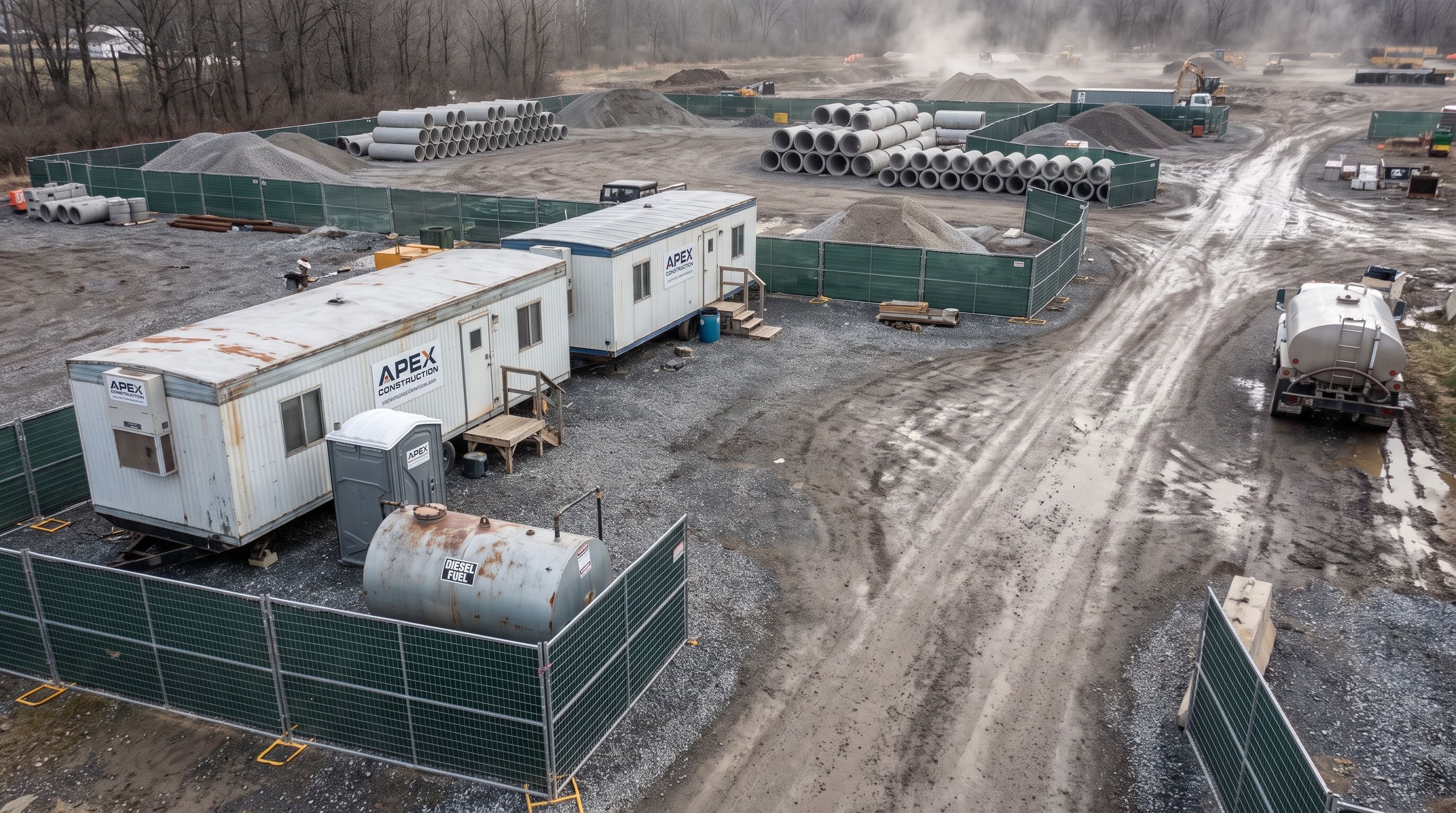
- Field office and yard setup: trailers, power drops, internet, sanitation, fencing, signage
- Laydown yard prep, gravel access, and stockpile areas
- Fuel tanks, lube trucks, service trucks, tool trailers
- Bonds and insurance premiums due at NTP
- Preconstruction submittals, shop drawings, schedule development, survey control
- Moving people — per diem, lodging, travel for out-of-area work
- Initial mobilization of subs where your spec allows it
And the part everybody forgets: demobilization. You're hauling all of it back out. Some specs pay demob separately. Most don't.
If the item is bid lump sum and it isn't in mobilization, it's buried in your unit prices or it's coming out of your margin. Those are the only two options.
The cap is not the price
Nearly every DOT limits what you can bid and what they'll pay early.
Ten percent of the original contract amount shows up over and over. Caltrans, MoDOT, and TxDOT all work off a 10% ceiling in some form — with MoDOT specifically holding anything above 10% until the project is accepted for maintenance. Not every agency is that generous. MassDOT's mobilization item has been capped at 3% of the contract bid total, and it's been litigated at the bid protest level.
Payment is usually stepped, too. A common structure looks like this: at 5% of the contract earned, you get 25% of your mobilization. At 10% earned, 50%. At 50% earned, 100%. TxDOT's version pays 90% of the lump sum — or 10% of the total contract, whichever is less — once 10% of the adjusted contract amount for construction items has been earned.
Read that again. You can bid a number the agency will never pay you in full.
So step one on every job is the same: pull the mobilization spec, find the cap, find the payment schedule, and write both on the bid sheet before anybody talks about a percentage.
How to price it from the bottom up
Percentages are a check, not a method. Build the number.
1. Count the moves
Not "the move." The moves. How many pieces, how many trips, how far, and how many times you're coming back.
Lowboy work is running roughly $4.00 to $8.00 per mile in 2026, and oversize or overweight loads that need permits, escorts, or route surveys can run $5.00 to $15.00 per mile or more. Diesel has been averaging $3.80 to $4.30 a gallon nationally, which is keeping fuel surcharges in the 15% to 22% range on top of linehaul.
Eight machines, 140 miles each way, two of them oversize. Do that math honestly and you're already north of $20,000 before a trailer hits the site.
2. Price the yard
A 12x60 office trailer with a couple of offices and a restroom rents for roughly $450 to $900 a month. Delivery runs $300 to $1,500, setup and leveling $200 to $800, and local permits another $100 to $500.
Then add the stuff nobody quotes: gravel for the access, the water meter, the temporary power drop, the fence and screening, the port-a-johns, the dumpster, the security camera.
3. Add the paper
Bond premium, insurance, builder's risk, preconstruction submittals, the schedule your PM is going to spend two weeks building, survey control, and the environmental permits you can't turn dirt without.
4. Add the people
If the job is 200 miles from the shop, somebody's paying for hotels and per diem before production starts. That's mobilization.
5. Now check your percentage
If your built-up number lands at 3.5% on a $6 million job, great — you know why. If it lands at 12% and the cap is 10%, you don't shrug and bid 10%. You figure out where the other 2% is going to live in the schedule of values, and you make that decision on purpose.
This is exactly the kind of thing that should be a repeatable template in your estimating system rather than a number somebody remembers. In Edgevanta we treat mobilization like any other buildout — line items, quantities, and history from what the last five jobs actually cost — so it stops being a guess.
The front-loading temptation
Let's be honest about what's really going on with mobilization on a lot of bids.
Contractors load it because cash early is worth more than cash late. Everybody knows it. FHWA knows it. That's why the specs are written the way they are.
A bid gets flagged as materially unbalanced when the payment structure would amount to an advance payment to the contractor, or when the agency would end up paying more than it would have paid the next bidder. If your mobilization is three times everybody else's and your late-job items are pennies, you're not being clever. You're handing the agency a reason to require justification, delay award, or reject you outright.
I'm not telling you to bid mobilization at cost with zero strategy. Unit price bidding is a game of where you put money, and I've said before that there's a right price for every job. But there's a difference between putting money where the risk is and building a bid that only works if the agency doesn't read it.
Know your true cost first. Then decide what you're doing with it.
The situations that wreck mobilization budgets
Multiple mobilizations on one contract
Phased work, IDIQ, work-order contracts, and anything with a winter shutdown means you're moving in and out more than once. Some specs have a separate mobilization item per work order. Many don't. If you bid one move on a job that requires four, you just donated three of them.
Small jobs
Mobilization doesn't scale down. Hauling a paver 90 miles costs the same whether the job is $80,000 or $800,000. On small work, mobilization can be 15% to 20% of your real cost, and the cap will not care. This is where a lot of contractors quietly lose money all season on jobs they thought were easy.
Remote and access-constrained sites
Bridge work over water, utility work in tight urban corridors, sites with a load-restricted county road on the approach. Route surveys, temporary matting, and permit lead times are all mobilization costs, and they don't show up on the plan sheet.
Owner-caused delay to NTP
Your equipment is committed, your crew is staged, and NTP slips six weeks. Read the contract for what you can recover, and price the exposure if you can't recover anything.
What good looks like
Before the bid goes in, somebody on your team should be able to answer all five of these:
- What does the spec cap mobilization at, and what's the payment schedule?
- How many separate mobilizations does this contract actually require?
- What's our built-up cost, line by line — not our percentage?
- Where is demobilization priced?
- If we're above the cap, where does the remainder live and why?
If nobody can answer those, you don't have a mobilization number. You have a placeholder.
The good news is this is fixable in one bid cycle. Build the template once, feed it with what your last few moves actually cost, and every job after that is a ten minute exercise instead of a gut call.
The bottom line: Mobilization isn't a percentage — it's an invoice you haven't received yet. Price it like one, and it stops being the item that quietly eats your first thirty days.
.avif)

.svg)