.avif)
How to Read DOT Bid Tabs (and Turn Them Into Your Best Pricing Tool)

Tristan Wilson
TL;DR: Bid tabs are the closest thing to your competitors' playbook that's legal to read. Every unit price, every bidder, every job — public record. Most contractors glance at who won and move on. The ones who study them bid smarter every single letting.
Every time a DOT opens bids, it publishes the results.
Not just who won. Everything. Every bidder, every line item, every unit price.
That document is called a bid tabulation — a bid tab — and it's the most underused piece of intelligence in heavy civil construction.
Here's the thing: your competitors' pricing isn't a secret. It's sitting on a state DOT website right now, free, going back years. The question is whether you're doing anything with it.
What a Bid Tab Actually Is
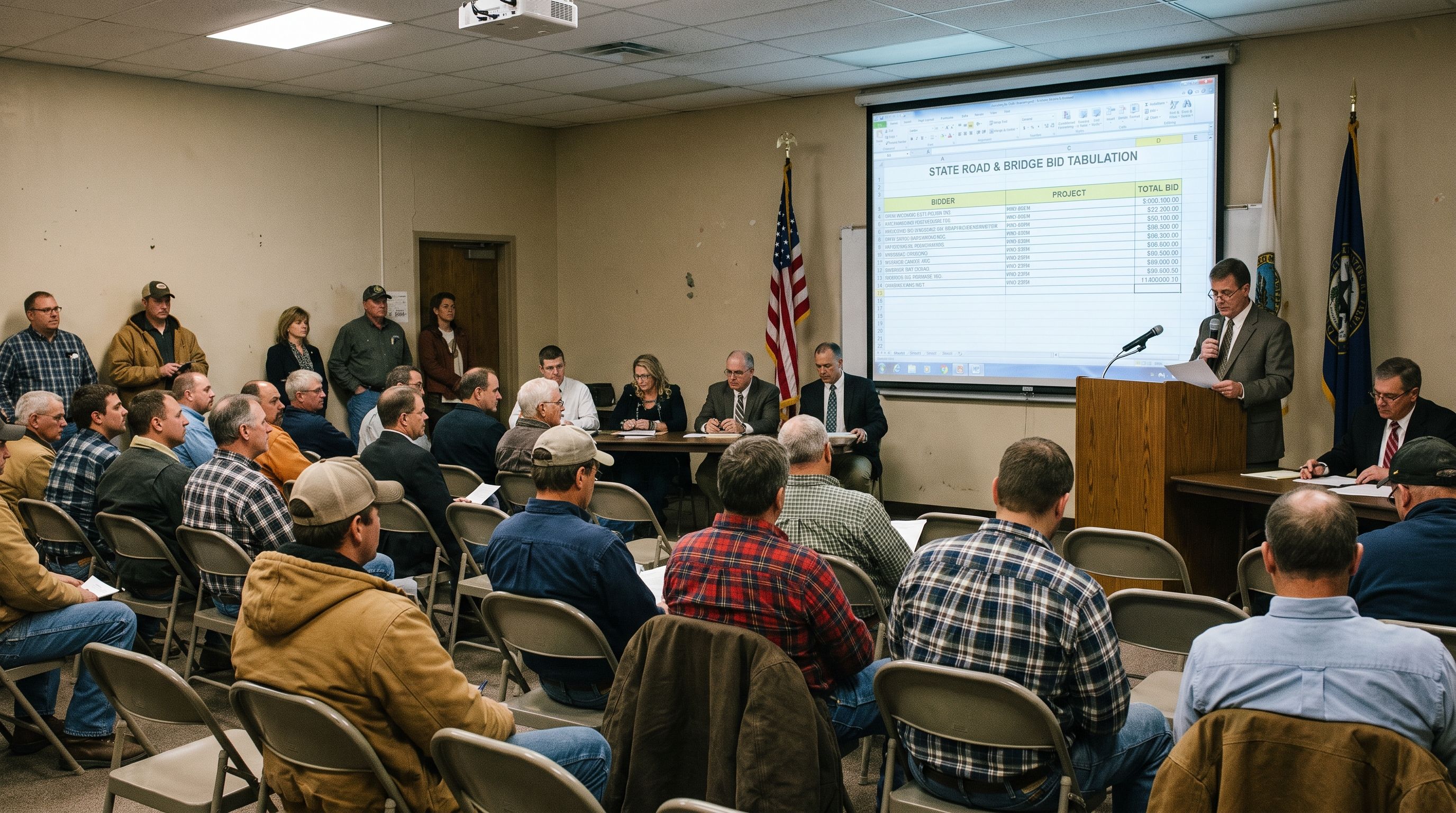
When a DOT holds a letting, contractors submit unit prices against the same list of pay items. After the bid opening, the agency tabulates everything into one document so the results can be compared line by line.
A typical DOT bid tab shows:
- The project header — contract or call number, county, route, letting date, work type
- Every bidder, ranked — apparent low to high, with total bid amounts
- The engineer's estimate — what the DOT thought the job should cost (most states disclose it; some don't)
- Line-item detail — each pay item's quantity, and every bidder's unit price and extension
Because DOT work is public money, bid tabs are public records. Most state DOTs post them within days of the letting. If a state doesn't post them online, you can request them under public records laws.
That last part matters. This isn't gray-area intel. It's how the system is supposed to work.
First Pass: Read the Totals
Before you touch a single line item, look at three numbers.
The spread between first and second
Tight spread — say, under 2% — means the market is competitive and everyone's reading the job about the same way. A wide spread means somebody saw something the others didn't. Maybe the winner has a plant next door. Maybe they missed something. Either way, it's a signal worth understanding, especially if the winner keeps doing it.
The gap to the engineer's estimate
Bids coming in under the estimate usually mean a hungry market — contractors chasing backlog. Bids consistently over the estimate mean costs have moved, the estimate is stale, or the job carries risk the DOT didn't price. Track this by district over a few lettings and you've got a market temperature gauge nobody else on your bid list is using.
The number of bidders
Two bidders on a job is a different market than seven. When you're deciding where to spend your limited estimating hours, bidder counts by work type and region tell you where the crowd isn't.
Second Pass: Read the Line Items
The totals tell you what happened. The line items tell you why.
This is where most people stop reading — and where the real money is.
Find where you actually lost
You didn't lose the job by 4%. You lost it on specific items. Put your unit prices next to the low bidder's, item by item. Nine times out of ten, the gap concentrates in a handful of lines — earthwork, structures, a big trucking number. That's not a bid problem. That's a specific cost problem you can go work on.
Watch the big items, ignore the noise
On most heavy civil jobs, 20% of the pay items carry 80% of the dollars. A competitor beating you by 30% on a $2,000 item is trivia. Beating you by 8% on a $1.5 million item is the whole ballgame. Sort by extension, not by item number.
Learn each competitor's fingerprint
Study the same competitor across ten tabs and patterns show up. Who's aggressive on excavation but fat on structures. Whose pricing drops when their backlog is thin. Who owns a district and who's just visiting. That's what turns bidding from a coin flip into a strategy.
The Trap: Money Gets Moved Around
One warning before you treat every unit price in a tab as gospel: not every price is real.
Contractors sometimes shift money between items you need to be aware of it and understand why items are priced that way and if that strategy will be replicated again. Know what risk your competitors are and aren't willing to take.
Turning Tabs Into a System
Reading one bid tab is interesting. Reading fifty is a competitive edge.
Here's the honest problem: doing this by hand is brutal. Pulling PDFs from a DOT site, retyping unit prices into a spreadsheet, normalizing item codes across lettings — that's hours per tab, and it goes stale the moment the next letting posts.
So most estimators do it once, for a big pursuit, and never again.
That's exactly why we built bid intelligence into Edgevanta — historical DOT bid tabs, searchable by item, competitor, and geography, so you can see who's bidding what, where, at what price, without the data entry. Our customers use it to answer questions in minutes that used to take an afternoon: What has this competitor been running on borrow excavation in this district? What did similar jobs actually let for last quarter?
Whether you use software or a spreadsheet, the discipline is the same:
- Pull tabs after every letting you bid — win or lose, while the job is fresh
- Log the big items — your price, the low bid, the engineer's estimate
- Tag the context — district, work type, bidder count, season
- Review before you price the next one — not after you lose it
Three Mistakes to Avoid
Treating averages as truth. An average unit price across ten jobs mixes balanced bids, money moved around on bids, different hauls, different quantities, and different years. Averages start the conversation; they don't end it.
Only reading tabs when you lose. The tabs from jobs you won tell you where you left money on the table. If you're winning by 8%, that's not always a win story — that's a pricing story.
Ignoring jobs you didn't bid. Tabs from lettings you skipped still show you who's hungry, where the market's moving, and what work types are getting crowded. Free scouting, zero estimating hours.
Using tabs to adjust your cost. Never ever adjust your estimate based on bid tabs. Get your cost right FIRST for every item. Nail the takeoff. Nail the unit costs. Get the best sub and supplier pricing. Then and only then do you want to start looking at bid tabs.
The Bottom Line
Every letting, your competitors publish their pricing in broad daylight. Most contractors never read past the totals line.
Don't be most contractors.
The low bidder tells you who won. The bid tab tells you how.

.avif)

.svg)