.avif)
How to Price Erosion Control and SWPPP Items on Civil Bids

Tristan Wilson
TL;DR: Erosion control isn't a materials cost. It's a maintenance cost with a materials cost attached. Price it by how long the job runs, not by how many feet are on the plan, or you'll fund somebody else's silt fence for fourteen months.
Nobody has ever won a job because of erosion control.
Plenty of contractors have lost money on one.
It's the item everybody prices last, usually by feel, usually off a per-foot number somebody wrote down three years ago. And it's one of the few line items on a civil bid where the quantity on the plan has almost nothing to do with what it costs you.
Here's the thing: you install most pay items once. Erosion control you install, repair, replace, inspect, document, and then remove. The plan pays you for the first part.
Why the E&S Line Behaves Differently
Every other item on the bid schedule is quantity-driven. Cubic yards of excavation. Tons of stone. Linear feet of pipe. You take it off, you price it, you build it, you're done.
Erosion control is duration-driven.
The same 8,000 linear feet of silt fence costs one number on a six-month job and a very different number on an eighteen-month job that sits through two wet seasons. The plan quantity is identical. Your cost is not.
That single distinction is the difference between an E&S line that carries a little margin and one that quietly funds the owner's site for a year and a half.
What the Permit Actually Obligates You to Do
Before you price anything, know what you're signing up for.
Under EPA's Construction General Permit, coverage kicks in for construction that disturbs one acre or more — or smaller sites that are part of a larger common plan of development. You need a Stormwater Pollution Prevention Plan, and the plan is a living document, not a binder in the trailer.
The obligations that cost money:
- Inspections. At minimum, once every seven calendar days. There's an alternative: every 14 days, plus within 24 hours of any storm producing 0.25 inches or more — but the 14-day option requires a functioning rain gauge on the site.
- Stabilization. Disturbed areas have to be stabilized when work has ceased and won't resume for more than 14 days. Your schedule drives this. A phased job with gaps buys more temporary seeding than a job that runs straight through.
- Documentation. Reports, corrective actions, SWPPP updates every time the sequence changes.
And know whose permit you're under. Most states run their own stormwater program with their own general permit, their own inspection frequency, and their own forms. The federal CGP is the floor in the places EPA is the permitting authority — it's not automatically your rulebook.
One Thing to Watch in 2026
If you're bidding work that runs into next year, this matters.
The 2022 Construction General Permit expires at 11:59 p.m. on February 16, 2027. EPA published its proposed 2027 CGP on August 3, 2026, and extended the public comment deadline to September 17, 2026. Sites that obtained coverage under the 2022 permit before it expires stay covered for a limited period while they file a new Notice of Intent under the 2027 permit.
Translation: on a long job, the permit you bid under may not be the permit you finish under.
That's not a reason to panic. It is a reason to read the contract language on regulatory changes and know who eats the cost if requirements shift mid-job. If you've got a comment worth making, the window is open right now.
Build the Estimate in Four Buckets
1. Installed BMPs
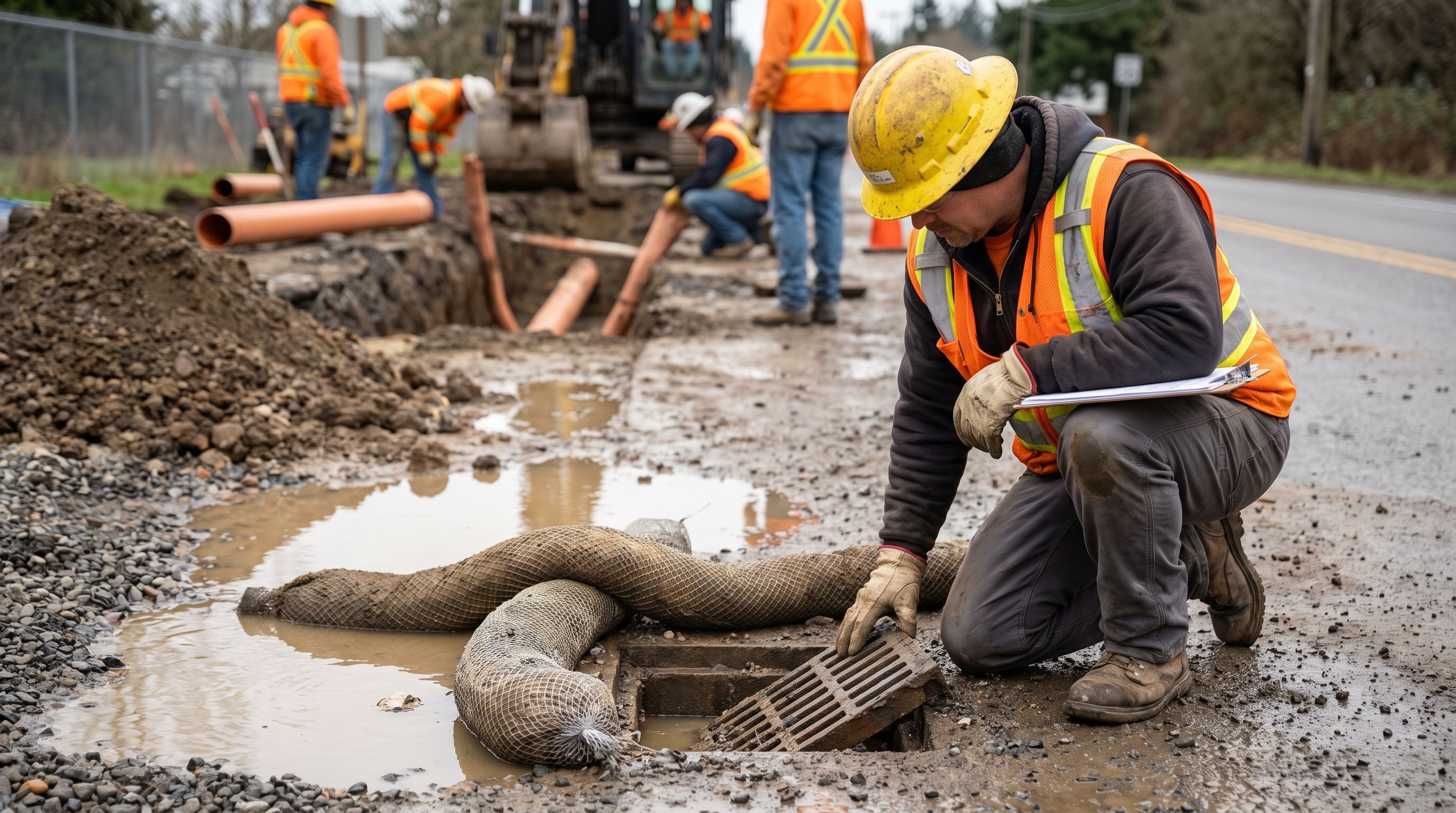
This is the part everybody already does. Silt fence by the linear foot, inlet protection each, blanket by the square yard, construction entrances each, seeding by the acre or square yard.
For a sanity check, one engineer's opinion of probable cost issued this month on a public project carried silt fence at $7.00 per linear foot, inlet protection at $110 each, erosion control blanket at $3.50 per square yard, a construction entrance at $1,870 each, a temporary sediment trap at $15,000 each, and seed and mulch at $0.80 per square yard.
Use that as a gut check, not as your price. It's one estimate, one market, one designer's assumptions. Your material, your labor, your haul.
2. Maintenance and replacement
Here's the bucket that eats people.
Silt fence gets torn out. Not mostly by storms — by your own equipment. A dozer working a slope takes out fence the grading crew put in last month. That's not weather. That's sequencing, and you can predict it if you look at the phasing plan while you're pricing.
So carry a replacement factor. If plan quantity is 8,000 LF and the job runs through two wet seasons with three grading phases, you are not buying 8,000 feet one time. Put a number on it honestly, even if the number is uncomfortable.
Then read the spec on maintenance. On a lot of DOT contracts, maintaining and repairing erosion control is incidental to the installed item — meaning you don't get paid again for the second install. If that's the case, all of it has to be in your unit price. Most of the losses I've seen on this item trace back to somebody assuming there'd be a pay item for repair.
3. Inspections and documentation
Somebody qualified walks the site every week — or every two weeks plus after every quarter-inch rain — for the entire contract duration. Including winter. Including the months when nothing's happening.
Price it like the labor it is: weeks of contract duration, times hours per inspection, times a loaded rate. Then add the rain-event trips, because those are unplanned, often after hours, and they include drive time to a job that might be ninety minutes away.
If your plan is "the superintendent will handle it," you've still got a cost. You've just hidden it in somebody else's line.
4. Stabilization
Temporary seeding, permanent seeding, matting on slopes, dust control. Driven by the 14-day rule and by how your schedule actually breaks up.
Look at the phasing before you price seeding quantities. A job that opens up 30 acres and then pauses is a very different seeding number than one that opens 8 acres at a time and closes them behind the grade.
Where the Money Actually Leaks
Pricing quantity instead of duration. Two jobs, same plan quantity, wildly different cost. If your unit price doesn't change with schedule length, it's wrong on one of them.
Assuming plan quantity is final quantity. E&S quantities move more than almost any other item on the job, and they usually move up.
Not funding the inspector. Weekly, all year, plus rain events, plus paperwork. That's a real position, not a rounding error.
Missing the word "incidental." One sentence in the spec decides whether maintenance is a pay item or your problem. Find that sentence before bid day.
Ignoring the wet season. A job that runs October through March in a wet region is a different erosion control job than the same scope in July. Same plan. Different cost.
The Risk You Can't Price Away
The fine is not the expensive part.
A stormwater violation can stop your job — not the erosion control crew, the job. Every day of that shutdown is burning equipment, crews, overhead, and float you may not have. Then it follows you into the next prequalification conversation with that owner.
Which is why the smartest thing in your E&S estimate is usually the boring thing: fund the inspections properly, so nobody ever has to explain to the owner why the fence has been laying flat for three weeks.
A Checklist You Can Run
- Confirm the permit — federal CGP or state program — and the inspection frequency it requires
- Read the maintenance language and find out whether repair is a pay item or incidental
- Price installed BMPs off your own material and labor, using published estimates only as a sanity check
- Add a replacement factor based on phasing and schedule length, not optimism
- Fund the inspector for the full contract duration, including shutdown months and rain-event trips
- Price stabilization off the phasing plan, not the total disturbed acreage
- Track actuals so next year's number is based on what it cost, not what you hoped
That last one is the whole game. Erosion control is the item most companies have never actually costed out after the fact — which is exactly why the estimate never gets better. It's one of the reasons we built cost tracking and historical data into Edgevanta: so the number you use next time comes from a job you built, not a memory.
The Bottom Line
Erosion control is the cheapest-looking item on the bid schedule and one of the most expensive to get wrong.
Price the duration. Price the repairs. Price the person walking the job every Thursday in February.
.avif)

.svg)