.avif)
How to Estimate Bridge and Culvert Work

Tristan Wilson
TL;DR: On structures, the permanent materials are the easy part. The money is won and lost on access, temporary works, and schedule — none of which show up as a line item on the bid form.
Most civil contractors I talk to are comfortable bidding dirt and pavement. Structures are where they get quiet.
I understand why. A grading job forgives you. If your production is off 10%, you push a little harder for a few weeks and claw it back. A bridge doesn't work like that. The sequence is rigid, the inspection is tighter, and one blown assumption on access can cost you more than the entire concrete pay item.
Here's the thing: that discomfort is exactly why structures work is worth learning to bid well. Fewer bidders show up. And the ones who do show up often price it like a materials takeoff instead of an operation.
Why Structures Work Deserves Your Attention Right Now
The demand isn't a guess. It's in the inventory.
According to 2025 National Bridge Inventory data, there are 41,600 bridges in the U.S. rated in poor condition — meaning the deck, superstructure, or substructure scored a 4 or below.
The money followed. For FY2026, $5.5 billion was set aside for the Bridge Formula Program, and the Bridge Investment Program under the IIJA totals up to $9.7 billion across FY2023 through FY2026. Average annual bridge spending during the IIJA period has run about $12.0 billion — roughly 22% higher than under the previous authorization.
That's a lot of structures going out to letting. The question is whether you can price them without giving the job away.
The Bid Form Is Not the Job
Open a typical DOT structures proposal and you'll see something like:
- Class A Concrete (Substructure) — CY
- Reinforcing Steel — LB
- Prestressed Concrete Girders — LF
- Structure Excavation — CY
- Bridge Deck Grooving — SY
Every one of those is a permanent material you can take off a plan sheet. And none of them is where your risk lives.
There is no pay item for the work trestle you need to get a 300-ton crane out over the creek. There's no pay item for the third formwork cycle you didn't plan on, or the pump running 24 hours a day for six weeks, or the two weeks your crew sits waiting on girder delivery.
The bid form tells you how you'll get paid. It doesn't tell you what it costs to build.
Build the Estimate Around Operations
The fix is straightforward, even if it isn't easy: estimate the operations, then assign those costs to pay items.
For a typical bridge, the operations look roughly like this:
- Site access, haul roads, and work platforms
- Demolition and traffic staging (if it's a replacement)
- Foundations — drilled shafts, driven piles, or spread footings
- Excavation, shoring, and dewatering
- Substructure — footings, columns, caps
- Girder setting
- Deck forming, rebar, and pour
- Barrier rail, approach slabs, joints
- Cleanup, restoration, and demobilization
Price each one as a crew, a duration, and an equipment spread. Then spread the total across the pay items. That's how you catch the costs the plan sheets don't show you.
The Five Costs That Sink Bridge Bids
1. Access and temporary works
Work trestles, causeways, crane pads, cofferdams, falsework. This is the single biggest miss I see, and it's rarely small.
These aren't afterthoughts to the industry either. After the falsework collapse on the Maryland Route 198 bridge over the Baltimore/Washington Parkway in 1989, Congress directed USDOT to develop specifications and guidelines for bridge temporary works — which is why FHWA publishes a guide design specification for falsework, formwork, and temporary retaining structures today.
Temporary works often need engineering, submittals, and inspection. Price the engineering, not just the timber and steel.
Some states even build this into their planning tools. VDOT's parametric bridge estimating tool includes a cofferdam modifier specifically because in-water foundation work changes the number that much.
2. Structure excavation and dewatering
Structure excavation gets bid by the cubic yard, and estimators price it like it's mass excavation. It isn't.
You're digging a small hole, in a confined area, with shoring, usually below the water table, often next to live traffic or a stream. Your production rate is a fraction of what a dozer and scraper spread does. Then you've got dewatering, settling basins, and turbidity requirements that can run for weeks.
Ask yourself: what's the actual bucket-hours number, not the CY-per-hour number from your dirt job?
3. Formwork cycles
Formwork cost is driven by reuse. If you can cycle a column form six times, your unit cost is one thing. If the columns are all different heights and diameters, it's another thing entirely.
Count the cycles. Count the strip-and-set moves. Price the crane or telehandler that's supporting them.
4. Crane time
Crane cost isn't the girder-setting day. It's mobilization, assembly, the certified pad, the lift plan, the standby days, and disassembly.
A crane sitting idle for four days waiting on a delivery is real money that never appears in a takeoff.
5. Schedule, weather windows, and specialty subs
Structures schedules are unforgiving because the work is sequential. Deck pours have temperature restrictions. In-water work has environmental windows that a permit — not your superintendent — controls.
And you're usually leaning on specialty subs: pile driving, drilled shafts, post-tensioning, bearing pads, joint systems. Get real quotes with real scope. "We'll carry a budget number" on a drilled shaft sub is how you find out in October that you were $180,000 light.
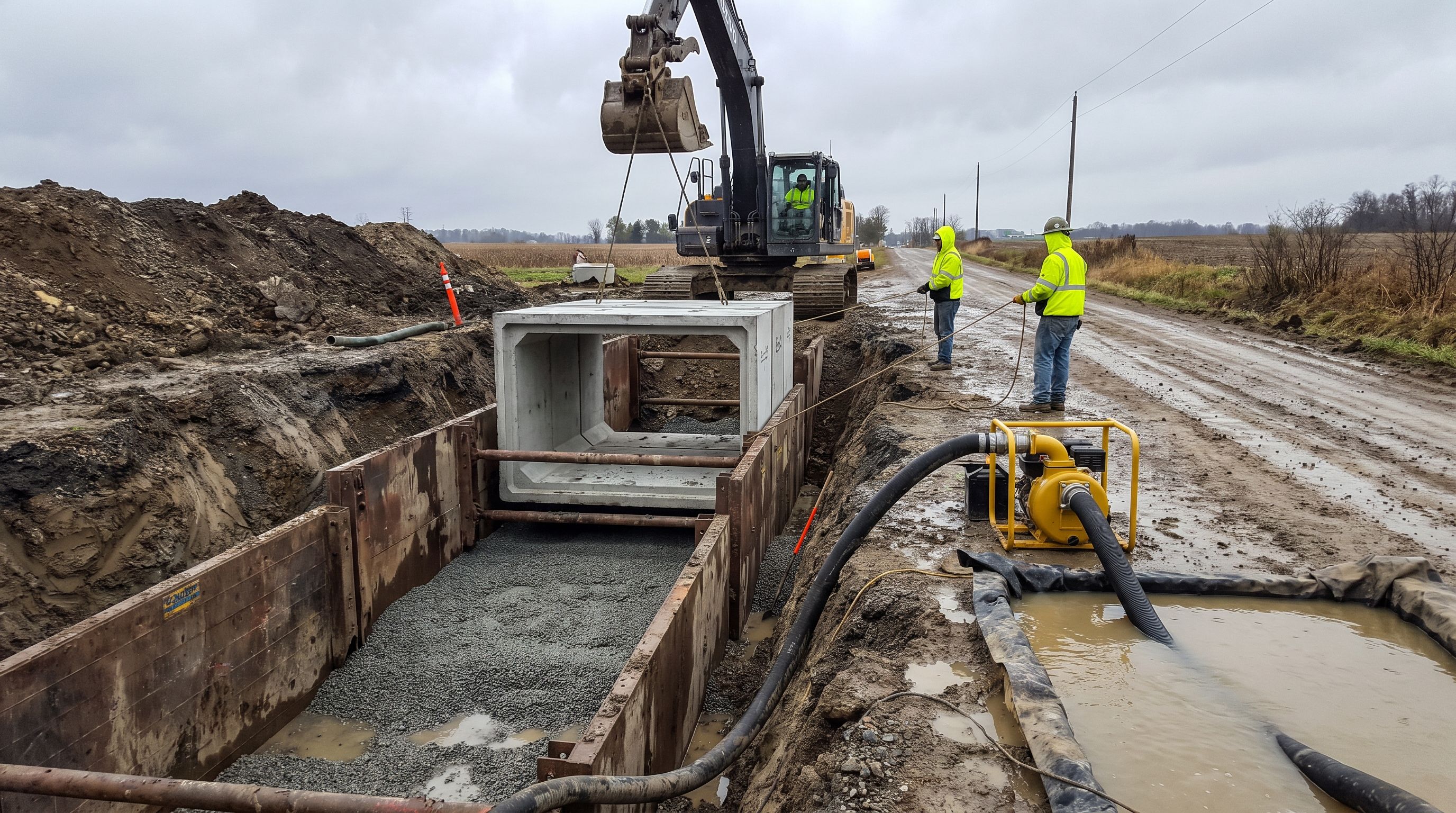
Culverts Aren't Small Bridges — Price Them Like Utility Work
Here's where a lot of contractors get crossed up. A box culvert looks like a structure on the plans, so they price it like a structure. But the cost behaves much more like a utility installation.
A precast box culvert job is really:
- Traffic control and staging (usually half-width construction, sometimes a full detour)
- Stream diversion, pumping, and erosion control
- Excavation with trench shoring
- Bedding stone, placed and compacted to spec
- Setting sections — crane or excavator, joint wrap, grouting
- Headwalls, wingwalls, aprons, and riprap
- Structural backfill in lifts, with compaction testing
- Restoration and channel work
Cast-in-place changes the math again: you're now carrying forming, rebar placement, cure time, and a much longer road closure.
Two things drive culvert cost more than the culvert itself:
Water. Diversion and dewatering on a live stream can easily exceed the cost of the pipe or box. Walk the site. Look at the flow. Ask what happens after a two-inch rain.
Time under traffic. If the road has to stay open, you're building the thing twice in halves, with two mobilizations, two traffic setups, and half the working room. That is not a 2x cost — it's usually worse than 2x on production and better than 2x on frustration.
The Quantity Checks to Run Before You Price Anything
Before margin, before strategy, before any of the fun parts — verify these:
- Structure excavation limits. Plan quantities are frequently based on neat lines that nobody can actually build to.
- Rebar weight. Reconcile the bar list against your own takeoff. Splices and bar supports add up.
- Concrete overrun. Deck thickness tolerance, girder camber, and haunch depth all mean you pour more than the theoretical yardage.
- Girder count, weights, and lengths. These drive your crane class and your delivery plan.
- Pile lengths. Are they plan lengths, or estimated lengths subject to field determination? That distinction is a risk allocation, not a detail.
- Approach work. Approach slabs, guardrail transitions, and grading tie-ins are routinely underestimated.
- Environmental commitments. Permit conditions, work windows, and monitoring requirements are cost.
Use Bid History Instead of Guessing
The good news about public structures work is that the answers are public.
Bid tabs will show you what your competitors carried on structure excavation, what the spread was on Class A concrete, and which contractors are actually chasing structures in your region versus which ones bid one a year to stay in practice.
Look for the unit prices with the widest spread across bidders. Those are the items where the market has no consensus — which usually means the item carries real risk, or it's being used to move money. Either way, it tells you where to spend your review time.
This is a big part of why we built Edgevanta the way we did: pulling DOT lettings and historical bid data together so an estimator can see how the market has actually priced a structure item before deciding where to put their number. It doesn't change your cost but serves as a sanity check and way to understand your market as deeply as possible.
The Sanity Check Before You Sign
Once you've got a total, back into a cost per square foot of deck area and compare it to your own history.
Those references won't bid the job for you. Nothing does. But if your number is 40% off the benchmark in either direction, you've got a conversation to have before the bid goes in — not after.
And run the same check on your temporary works as a percentage of total cost. If access, shoring, and falsework are coming in near zero, you haven't finished estimating.
The bottom line: on structures, you don't win on the concrete. You win on everything you had to build in order to pour it.
.avif)

.svg)