.avif)
How to Calculate Asphalt Tonnage (Without Getting Burned)

Tristan Wilson
TL;DR: The tonnage formula takes thirty seconds. The money is lost in the assumptions you feed it - depth, density, and waste.
Every paving estimator learns the asphalt tonnage formula in their first week.
And plenty of experienced ones still get burned by it - not because the math is hard, but because the inputs were wrong.
Here's the formula, a worked example, and the places the number goes sideways.
The Asphalt Tonnage Formula
To calculate asphalt tonnage, you need three numbers: area, compacted depth, and mix density.
Tons = (Area in sq ft × Depth in inches × Density in lb/cu ft) ÷ 24,000
The 24,000 is just unit conversion: divide by 12 to turn inches into feet, then by 2,000 to turn pounds into tons.
Standard dense-graded hot mix runs about 145 lb per cubic foot compacted. Your mix design will tell you the real number - use it.
Worked example
A 1,000 sq ft patch at 3 inches compacted depth:
(1,000 × 3 × 145) ÷ 24,000 = 18.1 tons
That's it. That's the whole formula.
The square-yard shortcut
Highway work is measured in square yards, so most estimators carry this rule of thumb instead: at 145 lb/cu ft, one square yard at one inch compacted is about 110 lb.
So: SY × inches × 110 ÷ 2,000 = tons. A 10,000 SY overlay at 2 inches is 10,000 × 2 × 110 ÷ 2,000 = 1,100 tons.
Where Tonnage Math Goes Wrong
The formula is never the problem. These are:
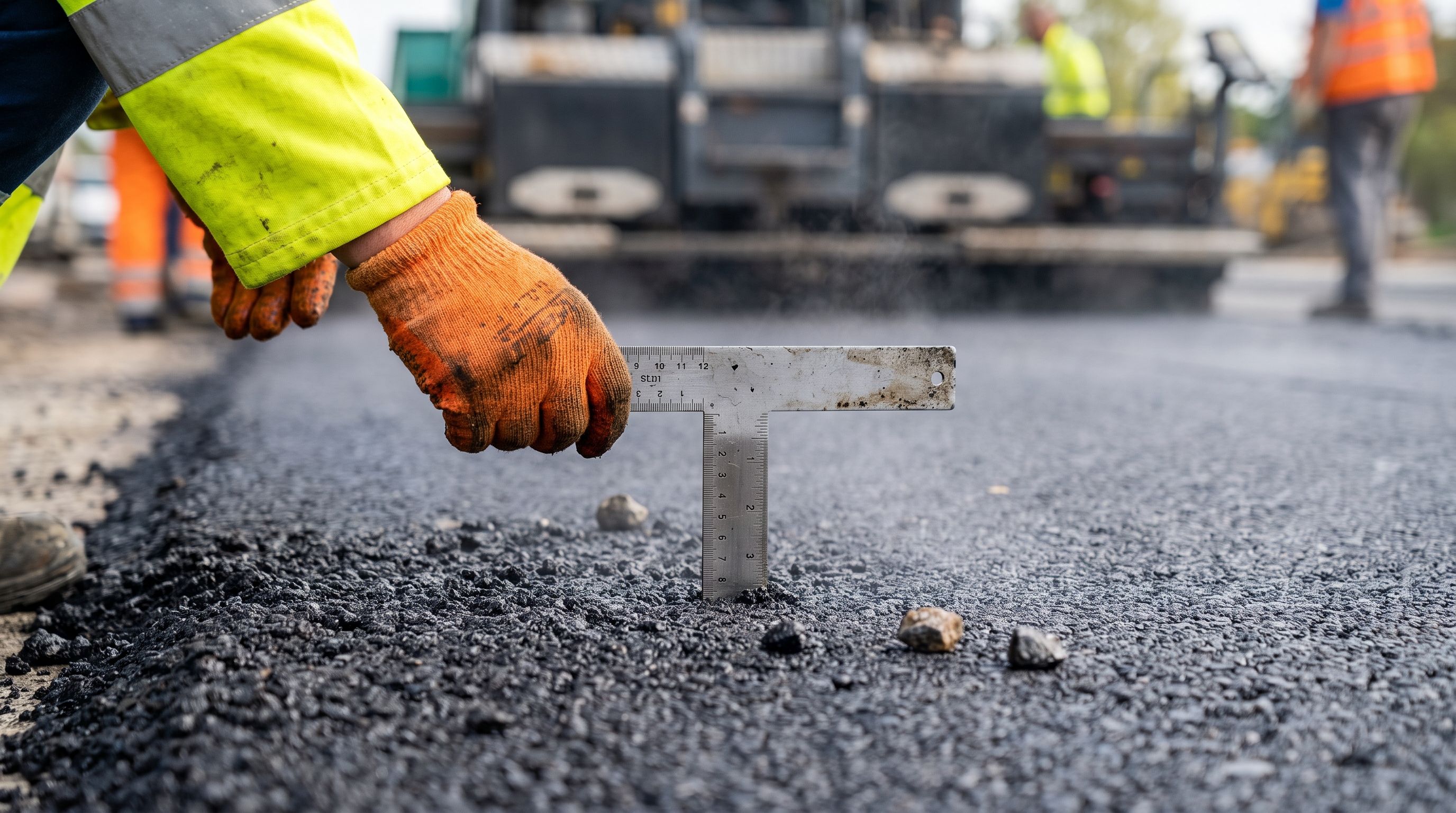
Depth isn't what the plans say
An overlay on a milled surface doesn't go down at a uniform 2 inches. Milling variance, cross-slope corrections, and leveling courses all eat mix. If the existing surface is rough, your real average depth can run well past plan depth - and every extra quarter inch on a big overlay is real tonnage.
Density isn't one number
145 lb/cu ft is a default, not a fact. Density varies by mix design - surface vs. base course, aggregate type, binder content. Pull the number from the actual mix design, not from a blog post. Including this one.
Irregular areas
Parking lots, cul-de-sacs, tapers, and radii don't come in clean rectangles. Break the area into rectangles and triangles, calculate each, and add them up. Eyeballing an irregular lot is how you end up a truckload short at 4 PM.
Waste and yield
Handwork, transitions, tack zones, plant and truck cleanout - mix disappears. Most estimators carry 5-10% for waste and compaction yield, more on small scattered patching where handwork dominates. Whatever your number is, make it a deliberate line, not a hope.
What Asphalt Costs in 2026
Once you have tons, the pricing is straightforward. In 2026, standard hot mix is running roughly $100-$150 per ton for material, with a national average around $115-$125. Trucking adds $10-$30 per ton depending on haul distance from the plant.
Two cautions on those numbers:
- They move with liquid asphalt binder prices, which track crude oil. Get plant quotes for your letting date, not last season's.
- Long hauls change everything. A rural job 40 miles from the nearest plant carries trucking costs that can rival the mix itself.
From Tonnage to a Winning Bid
Tonnage is the start of the estimate, not the end of it.
The number feeds everything downstream: trucking cycles, paver speed, crew hours, plant scheduling. Get the tonnage wrong by 8% and every one of those numbers is wrong by 8% too - in the direction that costs you money.
This is also where doing it by hand stops scaling. One patch, sure. A DOT letting with forty bid items and three mix types? That's takeoff and estimating software territory - tools like Edgevanta tie your quantities, mix designs, and historical unit prices together so the tonnage math is done once, consistently, instead of re-keyed across spreadsheets.
The Bottom Line
- Tons = (sq ft × inches × density) ÷ 24,000. Or SY × inches × 110 ÷ 2,000 for highway work (double shortcut = SY x Inches x 0.055)
- Use the density from your mix design, not the industry default.
- Plan depth is not real depth - milled and rough surfaces eat mix.
- Carry a deliberate 5-10% waste factor and own it.
- Price with current plant quotes; 2026 material runs roughly $100-$150/ton plus trucking.
The formula is free. The mistakes aren't. Measure the area, trust the mix design, and put the waste on paper.
.avif)

.svg)