.avif)
How to Bid Utility and Sitework Projects

Tristan Wilson
TL;DR: Utility and sitework jobs don't punish bad math. They punish bad assumptions.
The pipe is the easy part. What kills you is everything around the pipe - the dirt, the water, the rock, and the stuff nobody marked on the plans.
Here's the thing: on a paving job, you can see most of your work before you bid it. On a utility job, your work is buried under somebody else's guesses.
So let's talk about how to bid this work without betting the company.
Start With the Documents Most Estimators Skim
Before you take off a single foot of pipe, pull six documents: the grading plan, the utility plan, the paving plan, the detail sheets, the specs, and the geotechnical report.
That last one is the difference-maker.
The geotech report is the closest thing you get to X-ray vision. Soil classifications, groundwater elevations, rock. Ten minutes with the boring logs will tell you more about your real cost than an hour with the utility plan.
And read the specs for the risk-shifting language. Some owners do minimal subsurface investigation, write ambiguous documents, and make the contractor buy the risk. You need to know whether there's a differing site conditions clause, a rock clause, and who owns dewatering before you price the work - because if the contract makes it your problem, your bid has to say so.
Take Off Pipe by Depth, Not by Length
Rookie mistake: measuring 2,400 LF of 12-inch PVC and pricing it all the same.
A foot of pipe at 4 feet deep and a foot of pipe at 14 feet deep are not the same product. Different excavation volumes. Different trench protection. Different production rates. Different risk.
Break every run into depth brackets - 0-6 feet, 6-10, 10-14, and so on - and carry a separate production rate for each. Your crew might lay 300 feet a day in the shallow bracket and 80 feet a day in the deep stuff. If you blend that into one average, you're wrong in both directions.
Same discipline for structures. Manholes, inlets, and junction boxes get counted by depth and size, not lumped as "each." A 16-foot-deep manhole with a shored excavation is a different animal than a 5-foot doghouse.
Price crews, not pipe
Your cost isn't really per foot of pipe. It's per crew-day. The estimate that holds up is the one that says: this crew, with this excavator and this trench box, moves at this rate in this bracket. Pipe footage is just how you get paid.
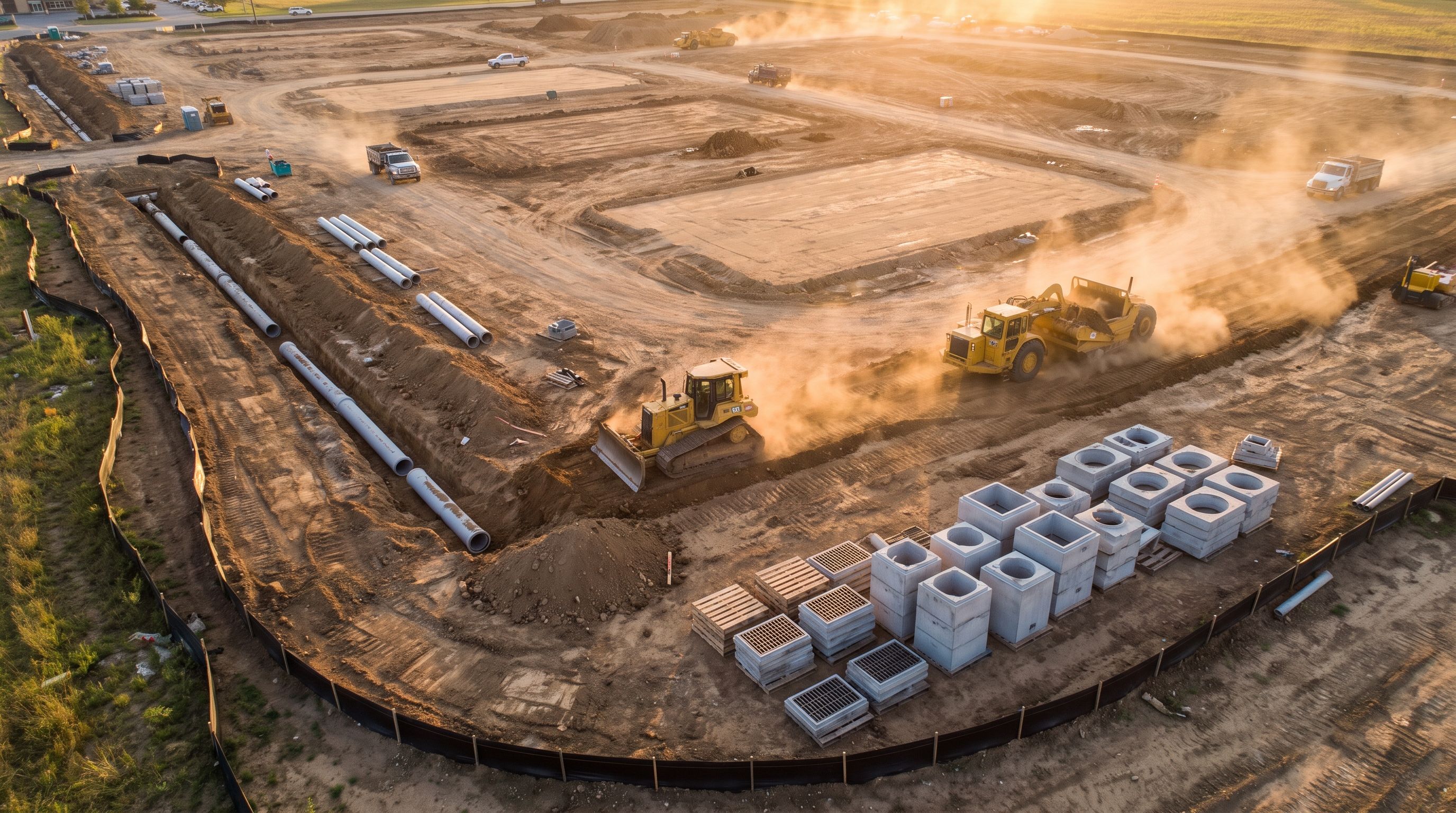
Price the Ground, Not the Plans
Three things live underground that will eat your margin if you don't price them: water, rock, and other people's utilities.
Groundwater. If the boring logs show water above your pipe invert, dewatering isn't a contingency - it's a cost. Well points, sump pumps, discharge permits, and the production hit of laying pipe in soup. Price it like it's happening, because it is.
Rock. Check how the contract defines it and how you get paid for it. If there's a unit price for rock excavation, quantify your risk honestly. If rock is incidental, your trench price better reflect the boring logs - all of them, not just the friendly ones.
Existing utilities. The marks on the plans are somebody's best guess. The industry standard (ASCE 38) puts utility information in quality levels, and only Quality Level A - actual potholing - tells you where things really are. If the owner did SUE work, use it. If they didn't, budget your own potholing on the critical crossings. A day of vacuum excavation is cheap insurance against a week of redesign - or hitting a gas main.
Trench Protection Is a Line Item, Not a Footnote
OSHA requires a protective system - sloping, benching, shoring, or shielding - in trenches 5 feet and deeper. At 20 feet, you need a registered professional engineer to design it. And a competent person has to inspect the excavation daily and after every rain.
That's not just compliance. That's cost: trench boxes, shoring rental, the slower cycle time of digging inside protection, and the competent person's time every single day.
Trench collapses still kill roughly a dozen workers a year in this country. The cheapest trench protection program is the one you actually priced into the bid - because the contractor who "saved" that money is either cutting corners in the hole or eating the cost in the field.
The Stuff That Sneaks Up on You
Ask any utility contractor where they've been burned, and it's rarely the pipe. It's the items around the edges:
- Restoration. Asphalt patching, curb replacement, sod, striping. On urban work, putting the surface back can rival the cost of the pipe underneath it.
- Testing and acceptance. Pressure tests, chlorination and bac-t sampling on waterlines, mandrel and camera testing on sewer. Each one is crew time, and failures are rework.
- Spoil handling. Is trench spoil suitable for backfill, or are you importing stone and hauling off waste? That answer can swing your trench cost more than the pipe material does.
- Traffic control. Flaggers, phasing, night work, plates. On road jobs this is a real crew cost every shift.
- Erosion control. Silt fence, inlet protection, SWPPP inspections - small numbers that turn into big ones when the job runs long.
None of these are exotic. They're just easy to shortchange when you're rushing a bid out the door.
Bid Strategy: Where to Put the Money
Once your costs are honest, bidding is a separate conversation. (If you've read this blog before, you know I keep those two apart.)
On unit price utility work, study which items historically overrun and underrun with this owner. Load your money into quantities you're confident will be there. Be careful with items that can vanish - if the engineer's rock quantity looks inflated and you've priced it fat, you just gave away margin that may never get paid.
And run a real bid/no-bid. Deep wet work in traffic for an owner who fights every change order is a different opportunity than dry, open-country pipe for a repeat client. Same margin percentage, wildly different risk. Price the job in front of you, not the average job.
This is also where knowing your competition pays. Historical bid tabs tell you who chases this work, how they've priced it, and where the market is. That intel is exactly what we built Edgevanta to surface - so the bidding conversation is grounded in data instead of gut feel.
Put It Together
A utility bid that holds up looks like this:
- Geotech report read before the takeoff starts
- Pipe quantified by depth bracket with a production rate for each
- Water, rock, and existing utilities priced from the borings, not from hope
- Trench protection carried as its own cost, every foot, every day
- Restoration, testing, spoils, and traffic control taken seriously
- Margin set in a separate conversation, based on risk and competition
Do that consistently and you'll lose some bids to contractors who guessed cheaper. Let them have those jobs.
The bottom line: Above ground, you bid what you can see. Underground, you bid what you bothered to find out.
We value your feedback, so please leave a rating below to help us improve the newsletter. Thanks for reading!
.avif)

.svg)