.avif)
Asphalt Overlay vs. Mill and Fill: Why the Estimates Are Nothing Alike

Tristan Wilson
TL;DR: An overlay and a mill-and-fill can put down the exact same two inches of asphalt. The estimates behind them share almost nothing. If you price a mill-and-fill like it's "an overlay plus a milling line item," you will lose money in at least three places - and probably not know which three until closeout.
Same surface course. Same tonnage on paper.
Completely different job.
Let's walk through where the money actually moves.
The Two Scopes in Plain Terms
Overlay: you clean the existing surface, tack it, and pave new hot mix directly on top. The road gets taller.
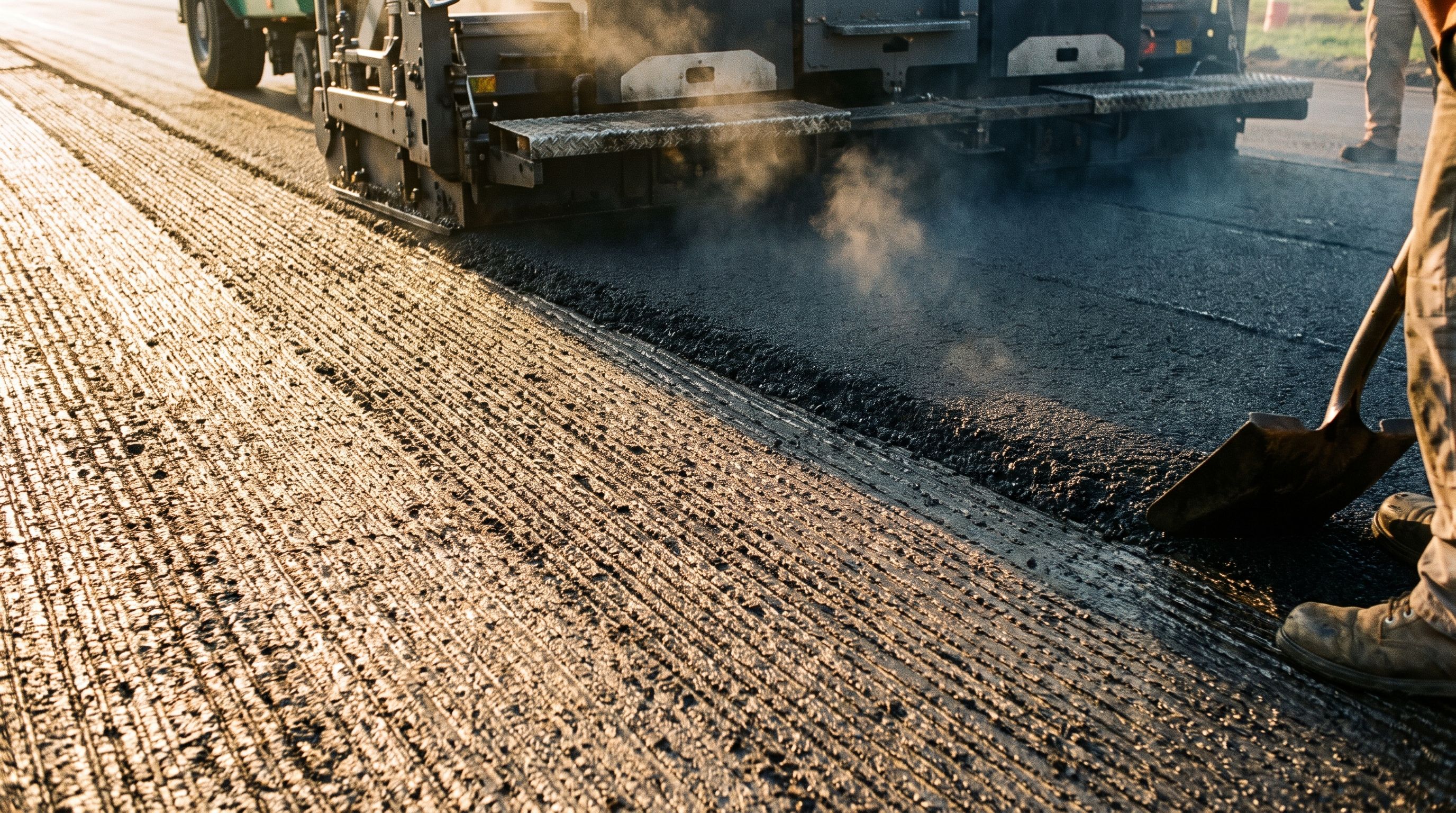
Mill and fill: a cold milling machine grinds off the top 1.5–2 inches (or more), you haul the millings away, then pave back to the original grade.
Owners don't pick mill-and-fill because they enjoy paying for milling. They pick it because an overlay raises the grade — and raised grade is a problem everywhere the pavement meets something fixed: curb reveal, gutter lines, guardrail heights, bridge clearances, driveway tie-ins, ADA ramps. Milling also removes the cracked, oxidized layer instead of burying it, so the new mat isn't inheriting the old surface's problems.
That's the engineering. Here's the estimating.
Where the Estimates Diverge
1. Yield: know the game you are playing
This is the one that quietly kills overlay-based pricing.
If you are overlaying an existing roadway without milling, you must account for more yield loss if running electronics to improve the ride of the final surface.
Run the plan number, then ask: who owns yield risk on this job? If you're paid lump sum or by the square yard, that overrun is pure cost. Price it.
2. Tack coat: more surface, more gallons
A milled surface has more surface area than a smooth one - all those grooves. Standard tack rates run about 0.04–0.08 gallons per square yard of residual, and milled surfaces need the top of that range.
Tack is a small number that estimators love to ignore. On 200,000 SY it stops being small. And skimping tack on a milled surface is how you end up with delamination and a warranty call that costs more than every gallon you saved.
3. Trucking: you're hauling the road twice
An overlay hauls material one direction: plant to job.
A mill-and-fill hauls both directions: millings off, new mix on. On a 10,000 SY job milled at 2 inches, you're hauling off roughly 800 tons of millings before the first ton of new mix arrives.
That's not just more truck hours. It's a scheduling problem: the milling machine needs trucks under its conveyor to keep moving, and your paving operation needs trucks at the same time if you're milling and paving in the same shift. Short the truck count and one of two very expensive machines sits idle.
Depth makes it worse in a way that isn't linear. Doubling milling depth doesn't double the milling cost — mobilization and traffic control are fixed — but it cuts the machine's travel speed and roughly doubles the haul trucks needed to keep up.
4. Milling: a production item wearing a unit-price disguise
2026 pricing guides put standard 1.5–2 inch milling at roughly $1.50–$4.50 per SY, full-depth at $3–$7, micro-milling at $4–$9 — plus mobilization ($2,000–$8,000) and minimum-quantity requirements from most milling subs.
But look at actual lettings and the spread is wild. One Arkansas DOT letting this January showed cold milling unit prices from $0.60 per SY on one project to $20.00 on another.
Same item code. Same state. 33x spread.
That's because milling cost is really a production calculation - depth, hardness, obstructions, handwork around structures, night work, traffic control, how far the millings travel —-flattened into a per-SY number. Quantity matters enormously: 2,000 SY of milling carries the same mobilization as 40,000 SY.
If you're bidding DOT work, this is exactly where historical bid tabs earn their keep. What has this item actually gone for, at this quantity, in this district? (Finding that fast across every letting you chase is a big part of why we built Edgevanta.)
5. RAP: the millings are worth something
Millings aren't spoil. They're Reclaimed Asphalt Pavement - feedstock for new hot mix, or base material someone will pay for.
If you run a plant, RAP coming back to your yard has real value against future mix costs. If you don't, there's still a market for it. Either way, the estimate needs an answer to three questions: who owns the millings per the spec, where are they going, and what's the round-trip haul worth?
Don't forget your RAP credit if you are a producer!.
The Overlay Isn't Free of Traps Either
Before this reads like overlays are the easy button:
- Transitions. Every place the overlay ends — intersections, driveways, structures — needs a butt joint or a milled key-in. Those milled transitions bring a milling mobilization into your "no milling" job.
- Leveling course. If the existing surface is rutted or wavy, you're placing a leveling course first, and leveling quantities are notoriously hard to estimate — it's one of the reasons owners choose milling instead.
- Surface prep. Crack cleaning and repair, patching failed areas. Paving over garbage just means the garbage telegraphs through in two winters.
Bid-Day Checklist
Stealing time on bid night? Run these five:
- Whose quantity governs - plan or actual? Yield risk lives here.
- What's the milled surface condition likely to be, and did I bump yield and tack for it?
- Who owns the millings, and did I price the haul (or the credit)?
- Do my truck counts cover milling and paving at the same time?
- What did this milling item actually let for at this quantity in this market?
The Bottom Line
Mill-and-fill isn't an overlay with a milling line tacked on. The milling changes the yield, the tack, the trucking, the schedule, and sometimes the entire cost structure through RAP.
Two jobs can leave the same surface. They never leave the same estimate.
.avif)

.svg)