.avif)
Aggregate and Trucking Costs in Civil Estimates

Tristan Wilson
TL;DR: On most civil jobs, the rock is the cheap part. The miles are what get you. If your aggregate line item is one number from one quote, you're not estimating — you're hoping.
Here's a number worth sitting with.
USGS puts the average unit value of crushed stone at roughly $18.50 per metric ton, up from an estimated $17.50 the prior year. That's the value at the quarry.
Now go price delivered stone in 2026. Nationally you're looking at something like $25 to $55 per ton for standard grades, and the regional spread is wider than that — northern states running $40 to $80, southern states $35 to $60, western states anywhere from $30 to $100 depending on how far you are from a pit.
Do the subtraction. The freight is frequently worth as much as the material. Sometimes more.
Which means an aggregate pay item isn't one estimate. It's two.
The Material Half
Start with what you're actually buying, because "gravel" isn't a spec.
Nail the gradation. #57, #67, crusher run, ABC, rip rap, select fill — they're different products at different prices out of different piles. Estimators who quote one and buy another find out at the scale house.
Compare quotes on the same basis. One quarry sends you FOB pit. The next sends you delivered. Putting those side by side and picking the low number is how you talk yourself into a bad job. Normalize everything to delivered-to-stockpile before you compare.
Watch the tons-to-volume conversion. You buy by the ton and you place by the cubic yard at a compacted density. Every one of those conversions is a chance to be off by ten percent, and ten percent of a base course item on a big roadway job is real money.
Price the waste honestly. Subgrade loss into soft spots, over-width placement, thickness tolerance, spillage on the haul road. The theoretical quantity and the ordered quantity are never the same number, and the difference isn't a rounding error.
Check the quote's expiration. Ask for validity dates and escalation language. A quote that expires before your notice to proceed is a conversation you're going to have later, at a worse price.
The Trucking Half: Build the Cycle
This is where estimates get won and lost, and it's not complicated. It's just arithmetic most people skip.
A solo dump truck runs north of $80 an hour, and rates north of $100 are common depending on market and configuration. Say you've got a tri-axle at $115 per hour carrying 25 tons.
Build the cycle in minutes:
- Load at the pit: 6 min
- Loaded haul: 22 min
- Spot and dump: 5 min
- Empty return: 18 min
- Scale, queue, contingency: 9 min
That's 60 minutes. One hour, one cycle, 25 tons. At $115/hour, your haul cost is $4.60 per ton. Add $22 FOB material and you're at $26.60 delivered.
Now move the quarry. Same truck, same rate, but the haul is 45 minutes loaded and 38 back:
- 6 + 45 + 5 + 38 + 9 = 103 minutes, or 1.72 hours per cycle
- 1.72 × $115 = $197.65 per load
- ÷ 25 tons = $7.91 per ton
- Delivered cost: $29.91 per ton
One variable moved. Delivered cost went up more than 12%. Nothing else about the job changed.
Then match trucks to production
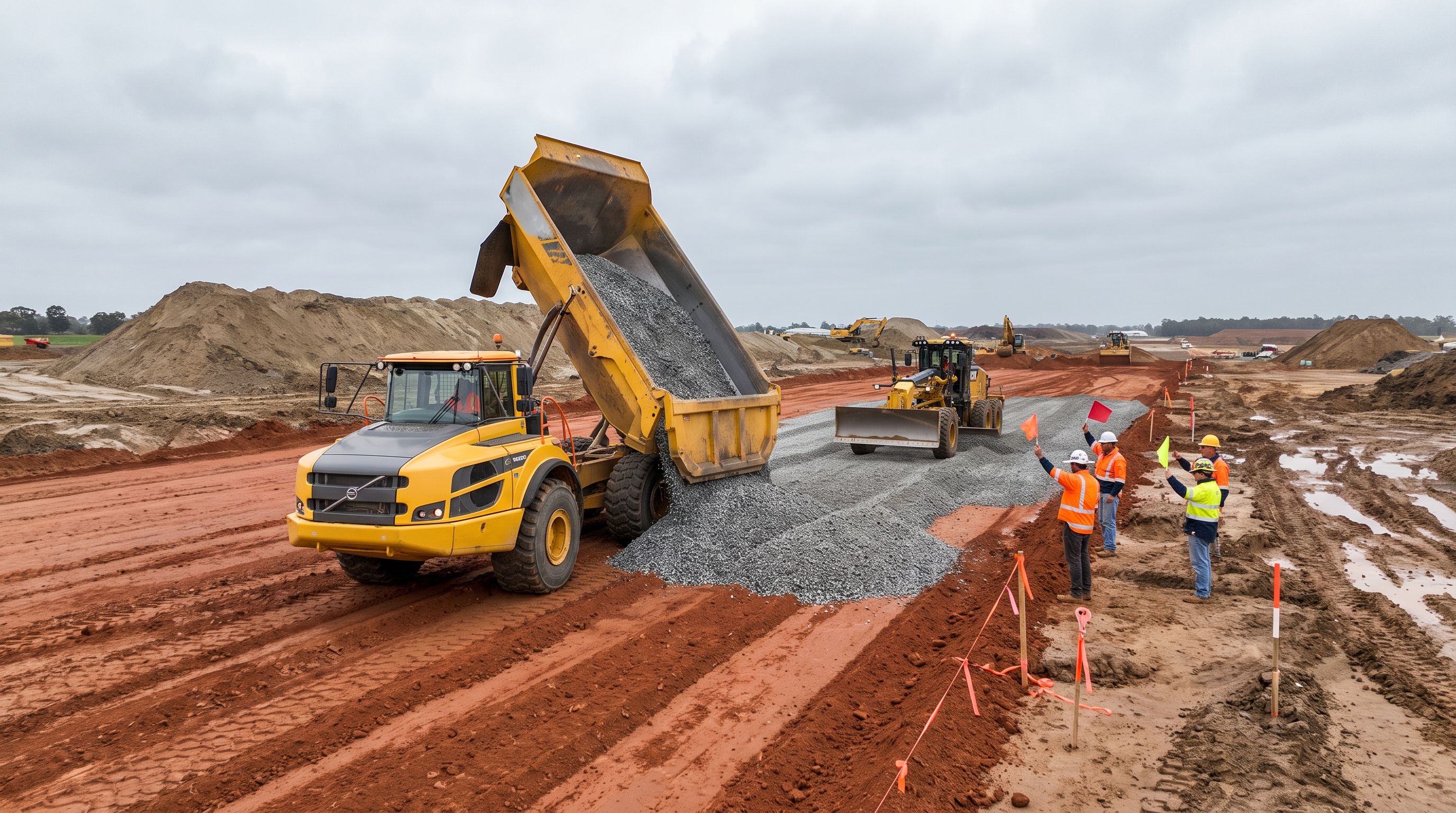
Cycle time doesn't just set your unit cost. It sets your truck count, and getting that wrong stalls the crew that's actually making you money.
Say the placement crew can take 1,200 tons in a day. At a one-hour cycle, each truck delivers 25 tons an hour, or about 200 tons over an eight-hour day. You need six trucks.
At the 1.72-hour cycle, each truck manages roughly 4.6 loads a day — about 116 tons. Now you need ten or eleven trucks to feed the same crew.
If you bid six and the haul turned out to be the long one, you didn't just miss the trucking cost. You bought yourself a grader crew standing around waiting for material, and that shows up in your production rates for the rest of the job.
The Costs Hiding in the Haul
Even a good cycle-time build misses money if you don't price the extras that live in a hauler's terms.
- Fuel surcharges. Most suppliers in 2026 run a floating surcharge — often in the range of 4 to 8% — that adjusts with regional diesel. If your bid is fixed and your surcharge floats, you own that spread for the duration.
- Per-ton hauling adders. Some haulers tack on a surcharge of roughly $5 to $15 per ton on top of the material price to cover labor and equipment wear. On a 20,000-ton item that's not a rounding error.
- Standby and idle time. Tight access, narrow roads, power lines, one-truck-at-a-time gates — expect idle-time charges commonly in the $60 to $120 per hour range. If your site can't take trucks continuously, you're paying for the queue.
- Minimums and premiums. Four-hour minimums, night and weekend rates, demurrage. Read the terms, not just the rate.
- Legal payload. A 25-ton assumption isn't universal. Weight limits, permit loads, seasonal frost laws, and posted bridges on the haul route all shrink what a truck can legally carry — which raises your per-ton cost without anybody raising a price.
Where Civil Estimates Go Wrong on This
Reusing last year's delivered number. Material moved, diesel moved, and the pit that served that job may not serve this one. Delivered pricing is job-specific by definition.
Measuring the haul straight-line. Trucks drive roads. Measure the actual route, at the actual time of day, with the actual restrictions.
Forgetting the export. Hauling spoil or unsuitable material off site is the same cycle-time math in reverse, plus a tipping fee. Plenty of estimates price the import beautifully and treat the export as an afterthought.
Single-sourcing the pit. Your number assumes one quarry. What's the cost if that pit is down, out of spec, or allocated to a bigger customer? The second-closest source is your real risk position — price it as a contingency you can name instead of one you discover.
What to Do Before the Bid
- Pin the gradation and spec for every aggregate pay item.
- Get at least two quarry quotes, FOB and delivered, with validity dates and escalation terms.
- Measure the haul on real routes, including restrictions and seasonal limits.
- Build the cycle time — load, haul, dump, return, queue.
- Size the truck fleet to the placement crew's daily production, not the other way around.
- Price surcharges and standby explicitly, as their own line, so you can see them at bid review.
- Check the bid tabs. What did aggregate and haul items actually let for on comparable jobs in that district? If your number is way off the market, find out why before you submit.
That last one is the check most estimators skip, and it's the cheapest one to run. Historical DOT bid tabs will tell you what the market has been paying for base course and hauling in a given geography — which is exactly why we made them searchable by item and competitor inside Edgevanta, instead of leaving them buried in letting PDFs.
The Bottom Line
Aggregate looks like the simplest item on the sheet. Quantity times a price per ton. Anybody can do it.
That's precisely why it's where money quietly disappears. The material price is public and competitive. The haul is where the variance lives, and the haul is what almost nobody builds from the ground up.
You don't bid rock. You bid the miles between the rock and the job.

.avif)

.svg)